Thursday, May 2, 2013

1975 Movie: Into the Rabbit Hole


Into the Rabbit, my group’s 1975 movie, revolved around a young man who fell into drug-dealing, the crooked cop who decided to work with him, and the rise and fall of their friendship.  As much as the film would be about the darker side of the city, and the business of drugs, it spend at least as much time focusing on their relationship.  The climax of Into the Rabbit Hole would come when the cop (played by Robert De Niro) has to choose between setting the protagonist (played by Jack Nicholson) up in order to cover himself, or remaining true to his friend.  In the end, he chooses power and security, opting to sell his “partner” out.  The last scenes would show Nicholson’s character in jail.  We wanted to pursue a darker tone to this movie, in order to discuss betrayal, crime, and the ambiguity of De Niro’s decision.  On the one hand, he turned in a criminal.  On the other, he shamelessly sold out his friend in order to save himself. This portrayal of the police as the villains plays into the 1970s characteristic of criticizing institutions, just as painting a criminal as the protagonist and victim goes along with the concept of anti-heroes that was so popular in that decade.  Because of this focus on crime and other dark topics, we thought this film would best be rated R.
Focusing on drug dealing, as well as the relationship between criminals and the police, Into the Rabbit Hole would fall into the genres of crime and drama -- a type of film in which both Nicholson and De Niro already had experience.
We chose to use Jack Nicholson and Robert de Niro as the stars of Into the Rabbit Hole, because they were both doing fairly high profile work around that time.  More, as De Niro had done another crime film only two years prior to 1975 called Mean Streets, and Nicholson had appeared in Chinatown only one year earlier, they were both clearly capable of both fitting into the genre and likely drawing interest from the public.  We decided to use Martin Scorsese as the director for similar reasons.  As he had also been the director of Mean Streets, he not only had experience working with De Niro, but would also likely be well-suited to make a crime film.
We would use William Reynolds as our editor, since had experience with a wide range of genres and films -- everything from The Sound of Music to The Sting.  Such an impressive resume recommends him as an excellent editor, which is exactly what Into the Rabbit Hole would need.  As it would often alternate between Nicholson and De Niro, we would want those shifts to be seamless and well done.
Given that we would also like this movie to be on the higher scale side, we opted to use Warner Brothers as our studio.  Not only was that the studio that did Mean Streets, giving it a history with both Scorsese and De Niro, but it also done big films such as Dirty Harry and Woodstock near that time.  It sounded like it would work well for our purpose.
I can’t think of anything much about which I disagreed with my group about this project...  When we were discussing the plot, I wanted a bit of a bloodier end, in which De Niro has to shoot Nicholson rather than arrest him.  Considering it now, though, I think that the ending we ended up choosing works better.  Although a death might have been more shocking to watch, it could easily have seemed too dramatic.  The one on which we decided seems more grounded on reality, and is almost more tragic for that fact.  

Monday, April 29, 2013

Formal Film Study S2: Jane Campion


Both a writer and director, both a maker of full length films and shorts, the Australian-born Jane Campion has built an impressive resume of awards for herself; impressive enough, at least, that I had a difficult time deciding which three to watch. I ended up choosing her first film Sweetie, the period romance Bright Star, and her Oscar Winning The Piano.

Sweetie, although Campion’s debut full length film, won her several awards upon its 1989 release -- the Georges Sadoul Prise in 1989 for Best Foreign Film, the LA Film Critics’ New Generation Award (1990), and the American Independent Spirit Award for Best Foreign Film. I can see why. Although I can’t say that it was comfortable to watch, I also can’t deny that it was extremely well done. In Sweetie, Campion explored family dysfunction by means of coal black humor and casual treatment of the graphic or ridiculous. Or perhaps ridiculous isn’t the right word; troubling may be more fitting. Overall, there was very little of Sweetie that wasn’t troubling on some level or other. Even the first few minutes of the film, set to a voiceover from the principle character Kay. Her immediately revealed thoughts, from her fear of trees to her bed memories concerning her sister, feel vague in the beginning but ultimately foreshadow two major parts of the movie. Sweetie, Kay’s sister, and the harm she played in her development are slowly revealed throughout the film. Trees pop up again and again, never signaling anything positive. It’s her reflections on trees that first imply she might be somewhat unusual. It’s a tree that marks the end of Kay’s love for her boyfriend Louis. And it’s a tree that plays host to Sweetie’s final, fatal tantrum. This related to Campion’s goal of showing this family’s metaphorical roots. Indeed, Sweetie seems to pull one deeper and deeper through the roots of not only Kay’s family tree but also her psychological state. The audience first meets awkward, abnormal Kay, the gains an introduction to Sweetie (Kay’s sister, as well as a harmful influence on her childhood development). Finally, their parents appear, the deepest set of roots, to provide even more information on how their family dynamic of indulgence towards Sweetie in complete place of Kay formed. Campion guides her viewers to the conclusion that, if one has bad roots, it will be extremely difficult for them to function in a healthy manner.
In a lot of ways, Sweetie reminded me of Campion’s short film Peel: An Exercise in Discipline. Both explore the quirks of a dysfunctional family, bringing the audience a bit too far into their lives for comfort. Both even feature a road trip at some point, as well as a blunt attitude toward behavior usually glossed over by Hollywood. I’ve seen exactly two films that show a women squatting outdoors to urinate -- both were by Campion. Such scenes, not to mention Sweetie’s casual incorporation of nudity, are utterly uncomfortable to watch, but that may well have been Campion’s aim. The characters themselves are forced to see Sweetie in such states, moved to such disgust; she forces the viewer as well to understand exactly how they feel.
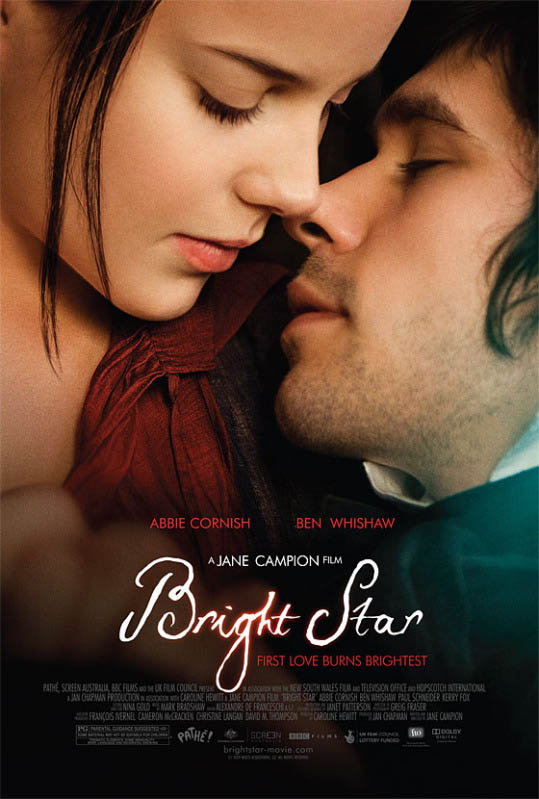

At first glance, Bright Star doesn’t appear to share much in common with Sweetie. Romantic, historical, PG, and poetic, it inhabited a completely different genre. Both focus on family life.  That’s the only surface connection I can draw between them. Sweetie was more artistic, its editing even periodically veering towards the experimental side with periodic cuts to close-ups of different foods and short switches to strange coloring. It found a firm place for itself among quirky films full of family dysfunction. Bright Star, on the other hand, would likely fit better next to an adaptation of Pride and Prejudice on a shelf. 
The majority of Bright Star was much less uncomfortable to watch than Sweetie. Fanny Brawne and John Keats made for far more likeable characters than any who appeared in the latter film, their relationships for a far more conventional and romantic love story. Bright Star lacked the more graphic and physically personal scenes that show up in several of Campion’s other films.  Even the setting was more pleasant. While Sweetie took a brief trip to the Australian outback, Bright Star depicted a greener side of a nature, as well as more than a few shots taken over beds of flowers. In short, it took less work to care about the characters and world of Bright Star. 
The main similarity I saw between the two films came toward the end of Bright Star. Upon Keats’ death, the camera follows Fanny as she leaves for another room in order to sob in privacy. Her attempts at privacy, however, do not cloak her from the view of the audience, nor even from the earshot of her family, as she becomes taken over by ugly, painful, and shrieking sobs. The scene feels so raw that it’s a bit hard to watch, much like the more disturbing moments in Sweetie. Campion leaves her audience no choice but to fall into whatever emotions her characters may be feeling by pulling them into nose-to-nose proximity with them. She doesn’t shy away from scenes of an extremely personal nature. 
She uses occasional silence as well in each film. It occurs during a few moments of Sweetie’s road trip, as well as on Fanny’s part throughout several her visits to Brown and Keats. The dialogue in Camption’s films is excellent, but she knows how to use silence to her advantage as well. This shows best in The Piano. 

Featuring a mute main character, The Piano keeps Holly Hunter in complete silence, save for a couple voiceovers, for the whole of the film. I was surprised that this worked so well, but Ada (played by Hunter) still seemed fully fleshed out, real, sympathetic, and intriguing despite her inactive vocal chords. It took The Piano to guide me to the realization that Campion’s skill lays at least partially in her characters (the female ones, in particular). A mute woman expresses more than most of the talkative females surrounding her, because of her gorgeous, soulful piano playing and emotive facial features. The latter is demonstrated most clearly in Ada’s piano lessons with George, through her alarmed shakes of the head and twists of the mouth that slowly transition to something more loving. It’s not only her, though. It would have been quite simple, not to mention likely much easier, to allow other main characters to become one-dimensional. Harvey Keitel as the heroic lover, Sam Neill as the villainous husband, Anna Paquin as the merely cute little girl. Every one of them, however, manages to surpass such flimsy labels. They do awful things. Keittel’s character George almost turned Ada into a prostitute, Neill’s Allisdair cut off one of her fingers in a jealous rage, Flora (Paquin) betrayed her mother’s trust and unintentionally pushing Allisdair into that destructive jealousy. Still, they’re understandable and even sympathetic at the same time. Campion forces her audience to realize why they act in such ways.

Campion’s characters often encompass her plot. Her films keep mostly to studying different emotions and relationships, from Kay’s with her family, to Fanny’s with Keats, to Ada’s with Allisdair, George, and Flora. For this reason, all three movies are slightly slower paced, but still engaging due to the enthralling nature of her characters.

I’ve seen The Piano called Campion’s “masterpiece,” and, from what I’ve seen of her work, I’d have to agree. It combines the best parts of Bright Star and Sweetie. The latter’s disconcertingly casual treatment of personal scenes appears, yet in a way that carries the former’s deep emotion and poetry (albeit through music rather than Keats’ poetry).

Each of her films also includes some kind of reoccurring motif or symbol, but nowhere so strong as in The Piano. Although the idea of trees emerges repeatedly throughout Sweetie, just as Keats’ poetry is spoken again and again in Bright Star, the meaning of Ada‘s piano, however, is the most explored of all three symbols. The final shot of it floating under water, not to mention its descent overboard on Ada, Geroge, and Flora’s journey to start a new life together, is absolutely beautiful. The former, matched against one of Hunter’s few voiceovers, shows what the viewer has likely already realized; the piano has served as Ada’s mouth, tongue, and words throughout the movie Images of the piano against her voice depict this well, as it could be the instrument speaking for her still, given the lack of other present figures. The piano’s fall over the side of the boat, on the other hand, plays a part of a different meaning; for as much as it had helped Ada, it had caused most of the drama in the movie. If not for the piano, Ada would probably have never fallen in love with George and upset her marriage. That she chooses to allow the ocean to swallow it seemed to show that her new life was to be free of such conflicts.

Overall, Campion’s films are most remarkable for their deeply emotional natures, character development, metaphors, and focus on females. Although her male characters are well-developed, there’s no doubt that Sweetie was telling Kay’s story, Bright Star Fanny’s, and The Piano Ada’s. More, the latter two movies incorporate a notable amount of female independence, although in different ways. Fanny always possessed wit and independence, but Ada had to strive for hers throughout the film, against the conventions of her new home. As much as the film closes with a relatively happy end to the romance between her and George, it also ends with her securing that independence.

Putting aside their different subjects, each film was incredibly well made. It’s no wonder Campion has such a award-heavy biography.

Wednesday, April 17, 2013

MYST Q2 #1: Before Sunrise


Boy meets girl on a train to Vienna. The boy -- an American set to return to the States the next morning -- asks her to spend the hours remaining until his flight wandering the city with him. The girl -- a French student on her way back to the Sorbonne -- agrees. 

The plot of Before Sunrise is fairly straightforward. Jesse, played by Ethan Hawke, meets Julie Delpy’s character Celine, and they spend about one day in Vienna, probing each other’s souls in conversations that touch on past relationships, past lives, animal mating habits, and a myriad of other topics. There’s no sudden drama thrown in -- no car crashes, no sociopaths, no kidnappings or injuries or crime of any kind. The only twists and turns are those that Jesse and Celine make on their path down the streets of Vienna. It’s the most simple romance I’ve ever seen -- and one of the best. 

Were the dialogue poorly written, the movie would have been an utter failure. The director Richard Linklater had no grand drama or rushes of adrenaline to force his characters into a fast-paced romance. He had only the conversations between Jesse and Celine to convince the audience of their abrupt love. Luckily, the script was wonderful -- witty and realistic. The dialogue blends humor and depth, successfully convincing the audience that two relative strangers may very well be soulmates. 
As there were no tertiary characters to relieve Hawke and Delpy of even a few minutes of screen time, Before Sunrise would have put its audience through roughly one and half hours of agony had either actor been unconvincing. Thankfully, Delpy and Hawke saved viewers from such torture. They were both so natural in their respective roles -- not to mention their chemistry -- that I almost felt as if I was spying on two actual tourists. 
This clash of reality and romance creates a hooking contrast. On the one hand, there’s nothing extraordinarily striking about the story. Jesse and Celine get to know one another through several hours of nonstop speaking. I’m sure that I’m beginning to sound like a broken record in emphasizing this, but it’s just so simple. At the same time, though, the whole movie feels like a bit of a dream.  They enter one another’s lives so suddenly. They fall in love so suddenly. And then, just as suddenly, they make their separate departures.
The scene following their farewell (as he continues on his way back to the States and she on hers to France) is, once again, striking because of its simplicity. Mirroring the beginning of the movie, the camera rolls over various longshots of Vienna.  This time, however, rather than the view from a train window, the audience sees the different locations that Jesse and Celine visited less than twenty-four hours ago -- a graveyard, an alley, a ferris wheel, a town square.  All significant to the story -- and all completely unaffected by the pair who passed through them.  Each is quiet, empty, and apparently untouched. The viewers, having watched Celine and Jesse visit each of these places, are the ones affected. The city is just as it has always been.  It’s one of the most genuinely bittersweet endings that I’ve watched recently. After spending 105 minutes traveling through Vienna with Jesse and Celine, you realize that nothing has really changed. Both protagonists are on route back to their respective homes, their plans for the future essentially as unchanged as the city. Despite a vague promise to return to Vienna the next year to meet again, there’s not any proof (save the sequel) that Jesse and Celine will be anything more than memories to one another. This adds to the dreamlike quality of their brief romance; by the morning after they meet, it’s as if nothing had ever happened.

Romance fans seeking an epic along the lines of Titanic may want to look elsewhere for viewing material. Otherwise, I’d highly recommend Before Sunrise to anyone looking for a romantic movie.  It's the most realistic -- if also idealistic -- romance I can remember watching.  It's simple and subtle and heart-wrenching.  To be honest, I’m a bit in love with it. I would give it four and a half out of five stars.

Saturday, March 23, 2013

MYST #3: Lady Jane


I have to admit that I wanted to watch Lady Jane more out of interest in Helena Bonham Carter than in the life of Lady Jane Grey.  She's just about my favorite actress, but I've seen very little of her early work.  As I couldn't find her first film A Room With a View, I went with Lady Jane, her second.  
It was one of the most enjoyable movies I’ve seen in a while. Carter was amazing (although I’m fairly certain that she could feature in a film about drying paint and I’d still give her a standing ovation) as the Nine Days’ Queen, Jane Grey.  I’d seen her in dark roles prior to this (her portrayal of Marla Singer in Fight Club jumps most immediately to mind), but Jane required a kind of darkness that I had never seen her portray before.  The victim of her parents’ political manipulations, Jane’s tragedy was her utter helplessness. Her problem wasn’t that she was weak or oblivious, but that she had no control over a single aspect of her life.  Her attempts to gain such a say upon becoming queen are genuine but fruitless. She, like every other adolescent portrayed in the film, is powerless.

Her romantic interest, played by The Princess Bride star Cary Elweys, suffers the same problem. Like Jane, he’s thrust into marriage by a parent who believes he can be easily manipulated.  Guilford (Elweys) and Jane’s marriage is the pure product of their parents’ belief that the couple can be easily controlled once they come to the crown. The young, ailing King Edward demonstrates the same idea; literally unable to care for himself, he’s persuaded into trusting every word of advice given to him by the conniving Duke of Northumberland (Guilford’s father).  The elder characters have complete control, and it’s their decisions that bring about their children’s bloody ends. Jane and Guilford wanted nothing to do with the crown, nor with the rebellion to keep it from Mary; that power struggle belonged entirely to their parents.  

This concept is most heartbreaking in the scene of Jane’s execution.  On her knees, she searches for the block upon which her head will be severed from her body, begging for someone to tell her what to do.  It’s impossible to ignore how young and helpless she is; how, in this final scene of hers, pitiful.  I thought at first that the movie might end with the swing of the executioner’s axe, but I’m glad that it went on.  The final scene of the birds soaring through the sky, the implication that Jane and Guilford can now enjoy their freedom, may be sentimental but it brought the movie together.  It fit with Jane’s previous musings of the birds, of the two times that she and Guilford swore that they would would “fly away” beyond the reach of their parents, so that they can be “nobody... nothing... each other’s.”  Lady Jane’s symmetry was one of its stronger qualities.  For instance, the contrast between the first time that Jane and Guilford declare one another’s wishes “done” as they throw full wine glasses, given to them by the Duke of Northumberland, to the floor contrasts nicely with the later moment in which they carry the same conversation while extinguishing the light from candles in an abandoned council room.  The former scene bursts with noise and rebellion, the latter with wariness and exhaustion. Previously, their only concern had been their ideals and newfound romance.  By the time they put out that last candle, they’d added a war, a crown, and possible execution to their list of worries.  It worked beautifully.

I’m torn over what to say of the romance between Jane and Guilford.  On one hand, it had no historical justification.  I’m not much of a history buff, but I’m fairly certain the Jane Grey enjoyed no grand romance with her husband.  Further, I felt that their transition from reluctantly-wed to besotted was a bit rushed.  The scenes of their happiness in general, were fairly insubstantial -- a well-lit montage of time spent idling outside together.  Those moments seemed as out of touch with the rest of the film as Jane and Guilford actually were from the court during their brief reprieve from political drama. At the same time, though, Jane’s romance with Guilford was necessary to their character growth.  As he remarks at one point, she thinks while he feels; they’re “two sides of a coin.”  Their romance might have been sudden, but, once established, it had an obvious purpose. It not only furthered their character development, but also the message of the harm parents can wreak by manipulating children as pawns.  During the short time for which they are free from adult authority and allowed to relish in idealism and romance, the audience sees them unburdened by worry.  And that brief note of joy adds to tragedy of the coming scenes.

If you’re looking for a period film, I’d definitely recommend trying Lady Jane. Although highly romanticized, it’s as heart-wrenching as one would want a film about such a tragic historical figure to be.  Also, Helena Bonham Carter was incredible.  Her performance alone is responsible for raising my rating of the film from three and a half stars to four.


Sunday, March 17, 2013

MYST Post #2: Jane Eyre


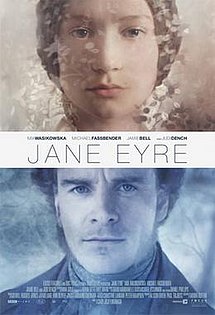
I’ll admit that I was wary when I slid the 2011 adaption of Jane Eyre into my DVD player.  Two hours seemed a bit too short to do Charlotte Bronte’s most famous novel justice, Michael Fassbender a bit too young and attractive to pull off the part of Edward Fairfax Rochester, and the reactions I'd heard too varied to give me much confidence in the film. Overall, however, I was pleasantly surprised. Director Cary Fukunaga might have cut out a few plot details, but he never sacrificed the overall feeling and message of the novel.  

 I was quickly proved foolish for doubting Fassbender's ability to portray Rochester.  Flashing back to his days as the fallen angel Azazeal on the British television drama Hex, he’s every inch the dark and tortured gothic hero.  I can’t think of one word of criticism for his performance. Handsome or not, he couldn’t played the part more flawlessly. Mia Wasikowska is just as impressive as the outwardly plain but inwardly passionate Jane Eyre.  Add in the almost tangible chemistry between them, and they are the perfect Jane and Rochester.

 Like any self-respecting gothic, Jane Eyre includes a lot of dark lighting, dark weather, and dark secrets.  This is clear from the first scene, in which the audience sees Jane collapse on the moors, mysteriously heartbroken and rain beaten. She’s even clothed in a dark dress.
Fukunaga’s decision to start his film in the middle of the novel had me nervous at first, but I was quickly won over.  The change is not only void of confusion, but serves as a clever way to speed the pace of the story to fit into 120 minutes.  Unlike past interpretations of Jane Eyre that begin chronologically with Jane's childhood, this version brings the audience straight into the action of her escape from Thornfield.  Using Jane’s time with St John and his sisters as a base for the story works well; it sheds an even more ominous light over each flashback, as the viewer is aware that no matter how happy Jane and Rochester might seem in the early days of their romance, it will all soon fall apart.

 And fall apart it did.  I have to admit, though, that I was surprised at the relative lack of drama present in the scene in which Rochester reveals his mad wife in her gothic prison. Although the acting and writing were both superb, there was something about it that felt fairly anticlimactic.  It may have been the lighting  -- it’s on the brighter side, which stands out in such an otherwise darkly lit film.  On one level this works well; it personifies the illumination of Rochester’s darkest secret, its exposure to the light of day.  More, it gives a fitting close to the brightly lit scenes of Rochester and Jane’s romance; from their engagement to their disastrous wedding, they often appeared amid high key lighting (the scene in which she accepted his proposal even includes a lens flare).  These scenes, as a result, possess a near dreamlike quality that, of course, comes undone along with Rochester’s secrets.  By the night of her failed wedding day, Jane has shed her white wedding gown for her darker, plainer dresses.  They have returned to the dark halls of Thornton Hall.  It almost felt as if the earlier, lighter scenes had come out of a dream. 

Aside from the lighting, Fukunaga relied quite frequently on nature to strengthen the gothic feeling of his film. There's the weather, which is often dark or on the cusp of darkening.  There's the gorgeous outdoor scenery.  And then there's the use of fire.  It not only appears in the candles and fireplaces within the gloomily lit Thornfield Hall, but it also seems to pursue a more metaphorical purpose as well.  The spreading of fire in Jane Eyre often precedes a dramatic change. When Rochester is saved by Jane from burning alive, they're relationship begins to deepen.  After a close-up on a flame growing through a fireplace, Jane tells Rochester that she must leave him.  And it's fire that seizes Thornton and blinds Rochester during Jane's absence.  The inclusion of fire also provides a parallel to Hitchcock's 1940s gothic romance Rebecca, and its final image of a burning Manderley.

 Fans of Jane Eyre partial to its romantic and gothic elements will likely enjoy this adaption.  I actually think it's one of the best adaptions I've seen. Overall, I would give it four and a half out of five stars.


Monday, March 11, 2013

1935 Movie: The Gambler


The Gambler is a drama that balances suspense and darkness with family values and redemption.  Ruined by the Great Depression, its protagonist (played by Clark Gable) turns to gambling as a means of supporting his wife (Joan Crawford) and son (Jackie Cooper) -- a plan that works well enough until he ends up owing money to one of his more powerful opponents (Robert Montgomery).  When Montgomery kidnaps Gable’s son in order to ensure that he gets his money, Gable is forced to sacrifice everything in order to regain his family’s safety.  My group and I hoped to promote family values with The Gambler, as Gable’s journey brings him to the realization that he must find a way to support his family in a respectable way; one of which his son can be proud.

We chose to use MGM as our studio, mainly because it was known at the time for its high profile movies, powered by high profile actors and actresses.  It was important to us that The Gambler possess those qualities.  The decision to use MGM for our movie led to the casting of Clark Gable as its lead.  He had done a lot of movies with MGM in the past, and -- although he had appeared in comedies like It Happened One Night -- he also had experience with tmore drama and adventure geared genres, given his role in films such as Call of the Wild and Mutiny on the Bounty.  In any case, he had proven himself to be versatile and more than capable of carrying a lead role.  We chose Joan Crawford for her affiliation with MGM, as well as for her history acting alongside Clark Gable in the 1931 drama Possessed.  Robert Montgomery seemed suited for the part of the villain, both because of his ties to MGM and because he had done, aside from his comedies, a number of dramas too (The Big House and Night Flight, for example).  More, all three were well known and likely to serve as a draw for potential moviegoers.

As for the director, Victor Fleming seemed like a good choice due to the high profile movies he would make with MGM in the future (The Wizard of Oz, Gone With the Wind, etc.), but also his connection to Clark Gable.  They had worked together before, on the MGM movie Red Dust; in fact, they worked on quite a few of the same movies.  We inferred from this that they would work well together on The Gambler.

We decided that The Gambler should rely heavily on editing, for the sake of building suspense, especially throughout the scenes that focus on the kidnapping.  Hugh Wynn’s extensive experience with MGM movies recommended him as the ideal editor.

Because of the Hays Code, we opted to exclude scenes of a sexual, obscene, or profane nature from The Gambler.  We would have to portray gambling, as it is so central to the film’s plot, but only in a negative light.  It would not receive a bit of glorification from our movie.  More, we would keep certain aspects of the kidnapping vague, highlighting the distress of the situation but not the specifics, in order to avoid showing illegal activity in a manner that might inspire criminals.

I can’t think of any huge decision about which I disagreed with my group.  I might have liked to keep the movie in black and white rather than color, but I can see the reasoning behind the choice.  Technicolor would attract more attention, and so possibly more of an audience.  Still, as there were plenty of successful films at the time that stayed in black and white (Gable’s Mutiny on the Bounty, for one), I wasn’t sure that it was a necessary expense.  

Monday, March 4, 2013

Formal Film Study: Sofia Coppola

 
At about one-year-old, she appeared in The Godfather -- as a baby boy. In 2004, she won the Academy Award for Best Original Screenplay. Sofia Coppola, the daughter of director Francis Ford Coppola, has worked as an actress, a screenwriter, and a director over her forty-one years. I chose to focus on her films The Virgin Suicides, Lost in Translation, and Marie Antoinette for my first formal film study.

The Virgin Suicides, released in 1999, was the first full length film that Sofia Coppola directed. Based on Jeffrey Eugenides’ novel of the same name, it tells the story of the Lisbon sisters, their eventual suicide, and the boys who grew obsessed with them. Although not my favorite out the films of hers that I viewed, I found it extremely enjoyable. It was interesting to see a dark comedy portrayed with such bright lighting. The lighting used to show the enigmatic Lux (played by Kirstin Dunst) was particularly bright; there were several artistic shots, for which the narrative was interrupted, in which she was shown bathed in sunlight. Even her name, given its Latin translation, connotes a sense of light -- which is a bit ironic, given the dark turns her life takes. Suicide stole her sister Cecilia, her first love abandoned her, her mother forced her into house arrest, and she shut herself away in a dark garage full of gas to die. As the narrator of the film acknowledges, by the end of their lives the Lisbon sisters are “becoming shadows.” It’s a dark story and she’s a dark character -- yet she’s shown again and again in the way that the narrators of the film (a pack of obsessed neighborhood boys) view her.  Drenched in light. Coppola frequently pairs her -- along with her sisters -- with the color white for this same purpose. It’s symbolizes purity in the most popular sense, but other cultures associate it with mourning -- a fitting motif for the film.
 
 The women of The Virgin Suicides may have been ill fated, but the film still has a feminist slant. It's the female characters who have ultimate control. Mrs. Lisbon is clearly the dominant member of her marriage. The Lisbon sisters hold the boys in their neighborhood completely captivated; years later, the male characters are still intrigued with the them, forever trying to solve their puzzle and forever unable to do so.  Even when the girls they kill themselves, it's on their own terms, with their secrets.  Further, the movie reveals the dangers of expecting women to be paragons of virtue.  That's what Mrs. Lisbon expected of her daughters, and that's why they felt so suffocated in the end.
 
Coppola’s award winning Lost in Translation varies quite a bit from Virgin Suicides in specifics. The latter takes place in a small suburb, the former in Tokyo. One follows a group of teenagers, the other a middle-aged celebrity and a recently married graduate of Yale. They both, however, focus on characters deeply dissatisfied with their lives and unable to communicate with certain members of their family (a wife in Bob’s case, a husband in Charlotte’s). On a more technical level, Coppola often relies on windows in her composition. In Virgin Suicides, the camera looks in through the window at the Lisbon sisters (for instance, the scene in which Lux fights with her parents is shot through a door's window without volume) -- the audience was kept as detached from them as the boys who narrated their story were. One of the more insightful comments the narrator makes about the girls (as well as the move in general) -- “We felt the imprisonment of being a girl, the way it made your mind active and dreamy and you ended up knowing what colors went together” -- has its roots in Cecilia’s journal rather than any actual relationship with the Lisbons. To watch The Virgin Suicides is almost to feel like a voyeur. In Lost in Translation, however, the viewer gets to look out the window with Scarlet Johanson as she stares at the city from the window seat of her hotel room. We get to share her loneliness, to know her, in a way that Coppola did not allow with the Lisbon sisters. The ending of each movie is ambiguous. The Lisbon girls remain a puzzle, even after their deaths. Coppola doesn’t reveal how either Bill or Charlotte’s future works out. Still, Lost in Translation is, at heart, a more hopeful movie than its predecessor. It’s about two lost souls who help each other, rather than two groups that never truly meet. The narrators of Virgin Suicides lose themselves in obsession, while the objects of their fixation eventually waste away, ever untouchable.


Marie Antoinette, the most recent of the films I studied and the last that I watched, was likely the most controversial. Critics like the Toronto Star’s Susan Walker described it as indulging “richly reproduced costumes and all-over gilt furniture, at the expense of any substance.” Peter Travers from Rolling Stone, however, said of it that, “With lyrical intelligence and scrappy wit, Coppola creates a luscious world to get lost in. It's a pleasure.” My take lays somewhere more in Travers’ direction. The film is decadent, but purposefully so. As Coppola said about the movie, "You're considered superficial and silly if you are interested in fashion, but I think you can be substantial and still be interested in frivolity."  The movie, in essence, is substantial frivolity. 
 If she opts not to commit to historical depth, then it’s because she focuses more on the character of Marie Antoinette than the circumstances of the time. Perhaps this is why it’s difficult to liken Coppola’s effort to other period films; it studies a girl who happened to live in the eighteenth century, rather than the century itself. The French Revolution is a mere backdrop that appears at the end of a film more focused on ornate costume design, emotional woes, the question of identity, and extravagant parties. Like The Virgin Suicides, it starred Kirstin Dunst (this time in the role of the notorious French queen rather than Lux Lisbon). Coppola contemplated similar issues with both characters, but allowed the audience to know Marie Antoinette more personally than they could Lux. While both characters were the subjects of near constant gossip, most of what we saw of Lux was shown through lens of that gossip.  Gossip about Marie Antoinette was incorporated, but it was often set over her scenes, allowing the viewer a proximity to the character herself rather than simply her reputation.  There were scarce few scenes that stole the viewer away from Marie Antoinette’s side.


All three films are more character-focused than plot-centered. They follow their characters through their everyday lives, rather than through a physically dramatic situation. In a way, Coppola’s films seem to be on the more psychological side. She could have made them more dramatic by actually showing the Lisbon sisters commit suicide or focusing more on Marie Antoinette’s bloody end. She chose instead to convey the everyday events that brought them to that point. It may keep the movies at a slower pace, but it better suits their purpose. More, it better suits Coppola’s style. 

The beginning of each film shares a commonality, too. Coppola often starts with a few relatively still scenes that say something about her characters. In Virgin Suicides, she juxtaposed shots of a quiet suburb with one of Cecilia bleeding to death in her bathtub. It foreshadows the contrast that the entire film explores -- the peace on the outside, the conflict within. Lost in Translation begins with Scarlett Johansson laying in bed -- more specifically, a shot of her pink underwear -- and then one of Bill Murray riding a bus, separated from the city by a window. Both images connote a sense of loneliness. A man not only separated from the world by glass but not even looking out at it. A woman alone, curtained away from the city, and facing away from even her hotel room  window. Finally, in Marie Antoinette, Coppola first shows her principle character laying languidly in an extravagant bed against the voiceover of her mother deciding her fate.  She's entirely passive, with no control over her own life.  Each scene says something important about what's to come.
 
Overall, the value of Sofia Coppola’s films can be found in her manipulation of light, use of stillness and silence, detailed character development, slower pacing, and purposeful scenery. She cuts a place for herself in the film industry outside of her father (although Francis Ford Coppola does produce a few of her films including Marie Antoinette and Virgin Suicides).  Her work is extraordinarily visual, whether set in a suburb, a hugely populated Japanese city, or a French palace. I enjoyed each film of hers that I watched, though I’d call Lost in Translation the most impressive.