Thursday, May 16, 2013

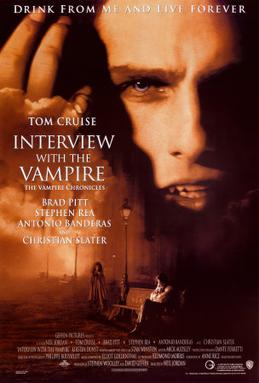
MYST Q2 #3: Interview with a Vampire


Fans of vampires more interested in vampire lore than in angsty teenage romance may enjoy Interview with a Vampire, Neil Jordan’s adaption of Anne Rice’s cult novel.  Following the centuries old Louis de Pointe du Lac as he tells the tale of his life as a vampire, it leaves its audience with a grim view of eternal life.


The cast was as remarkably high profile as they were well chosen.  Pitt was extremely convincing as the brooding and tortured Louis, while Tom Cruise made a surprisingly perfect Lestat. No one could have better woven the dark horror of his character with a twisted -- though equally dark -- humor.  Even the youngest cast member, a twelve year old Kirsten Dunst, was equal parts entertaining and haunting as the child vampire Claudia, trapped forever in the body of a pre-adolescent girl.

The scenery too had a certain pull. Traveling from New Orleans to Paris, to one ornate home to another, from one dingy alley to the next, it upheld a constant dichotomy between the glamor of life as a vampire with its darker core.  In general, one of Interview with a Vampire’s greatest strengths was its visual success.  Everything from the costumes to the make-up (which transformed Pitt, Cruise, and Dunst into a flawless blend of beauty and eeriness) was very much to the movie’s credit.  The set decoration was even nominated for an Oscar in 1995.

The art direction certainly contributed to the intensely gothic atmosphere that dominated Interview with a Vampire.  It felt almost too gothic at times, however, edging precariously close to becoming cliche. The script was occasionally marred by the same flaw.  Lestat’s frequent references to vampirism as a “dark gift” were unintentionally laughable.  Yet this is may be the product of the movie’s age rather than its writing.  With the mess of vampires vying for our screens today, with everything from movie franchises such as the Twilight Saga to television programs such as True Blood and Vampire Diaries in competition, it’s easy to forget that Interview with a Vampire was released far before that trend.  Anne Rice may well used such overdone language long before it became cliche.  

There were other points, however, at which things seemed almost overdone.  Lestat’s (first) murder by Claudia, for instance, seemed to want to be scarier than it was.  Although gory and a tad disgusting, the obscene amount of blood that pooled out from his body was never terrifying.  The slow close-up onto his rapidly paling face was less horrifying than it was uncomfortable.

Interview with a Vampire’s place in the horror genre is better secured by its more subtle terrors.  The figure of Claudia, for instance, was both tragic and terrifying. Kirsten Dunst somehow created the impression that she truly was a decades old monster, just as sophisticated and sensual as either Louis or Lestat, stuck forever in the body of a little girl.  Plots like that one are what ultimately elevate this film above other vampire movies in my opinion.  Louis and Lestat were both wonderful, but it’s become incredibly easy to come across stories that feature a brooding, sympathetic vampire alongside one who relishes his nature.  Angel and Spike from Buffy the Vampire Slayer, Stefan and Damon Salvatore from Vampire Diaries...  the list goes on.  Louis and Lestat may have been earlier, arguably even superior versions of this trope, but it’s the character of Claudia who becomes the most haunting.  More, although the movie lacks a true plot, the bare bones of a storyline that it does have revolve more around her than Louis.  Louis may narrate the story, but she's its center.  She takes much more action than her “father,” channeling her eventual loathing of Lestat into violence instead of sulking.  Even when Louis does become a more active protagonist, burning and killing a theater company of vampires, he does so only because of Claudia.  Dormant heartbeat aside, she gives life to the film.

I have to admit, I may be a bit biased towards this movie.  Despite their present punchline status, I’ve always been a fan of vampires, particularly those created by Anne Rice.  I really enjoyed this adaption of her work for its unwavering recognition of the fact that eternal life as a vampire would be a sort of hell.  I’d give Interview with a Vampire three and a half out of five stars.


MYST Q2 #2: Dorian Gray (2009)


Dorian Gray had the potential to be an incredibly entertaining movie.  It would have been difficult to find a more convincing Dorian than Ben Barnes, a better Lord Henry than Colin Firth. The sets, giving full life to the extravagances of society life in Victorian England, were impressive enough.  It even had the writing of the incredibly witty Oscar Wilde from which to draw inspiration.
Unfortunately, most of its potential went entirely unmet. Had director Oliver Parker attempted to create critique on the aristocracy imbued with subtle horror, the movie may have been enjoyable.  By forcing the classic novel The Picture of Dorian Gray into the mold of a thriller, however, I can’t help but think that he doomed himself.

The beginning of the film wasn’t terrible.  In fact, some of it was rather enjoyable.  Ben Barnes did a wonderful job of portraying Dorian Gray’s descent from an innocent young man to a thoroughly corrupted hedonist.  The introduction of the portrait’s power to absorb the evidence of misdeeds was, at first, understated enough to scare.  Its nightly wailing was a bit much, but not overly detrimental.  A close-up on the painting, however, in which it screeches a gasp at the camera had a more comedic effect than likely intended.
If the first half of the film had a flaw, it was an oversupply of explicitly.  Although I can see the need to show a scene or two Dorian’s debauchery, but I can’t help but think that Parker got a bit carried away.  It reached a point at which proof of Dorian’s promiscuity was no longer needed, at which these incredibly graphic sexual scenes began to hinder the progress of the film rather than add anything of worth.  
Overall, the first half of the movie was unimpressive, but at least entertaining.  Dorian Gray didn’t begin to verge on unwatchable until its ending.  

When Dorian returns to London from an extended vacation and falls in love with Lord Henry’s daughter, fostering hopes of redemption from his past sins, my opinion of the film began to fall rapidly.  Not for any of those plot points exactly (though Dorian’s affection towards Emily Wotton was somewhat unnecessary and unbelievable), but for the fact that this newest romantic development of Dorian's prompts Lord Henry to begin plotting his old friend's ruin.

Given an utter lack of prior evidence that Henry cares a bit about his family, or  about anything at all for that matter, no amount of skill on Firth’s part could save this shift from seeming entirely out of character.  

And it gets worse.

Dorian’s quest for redemption would have been much more powerful had he been the one to destroy his portrait.  The scene itself would have been more meaningful if it were kept understated, with only Barnes and the painting to occupy the audience’s attention.  But no.  Parker instead decided to have Henry set fire to the portrait and then lock Dorian inside the attic, opting for action over depth.  Dorian’s decision to then stab his portrait, once he’s already trapped inside a burning room, doesn’t give the audience much proof that he's changed, as he was already doomed to die at that point.  The close-up of his portrait’s face emerging from the canvas, as well as the lengthy shot of the aged, disfigured version of Dorian burning failed to provoke a sense of tragedy or horror.  They suffered from the same flaw that afflicted the majority of the film -- a pursuit of graphicness at the expense of emotion.  

I haven’t seen the 1945 adaption of The Portrait of Dorian Gray, but I may watch it at some point out of hope that it will do Wilde’s story more justice than this one did. Overall, Dorian Gray (2009) was a terrible disappointment. I would give it two and a half out of five stars.  


Thursday, May 2, 2013

1975 Movie: Into the Rabbit Hole


Into the Rabbit, my group’s 1975 movie, revolved around a young man who fell into drug-dealing, the crooked cop who decided to work with him, and the rise and fall of their friendship.  As much as the film would be about the darker side of the city, and the business of drugs, it spend at least as much time focusing on their relationship.  The climax of Into the Rabbit Hole would come when the cop (played by Robert De Niro) has to choose between setting the protagonist (played by Jack Nicholson) up in order to cover himself, or remaining true to his friend.  In the end, he chooses power and security, opting to sell his “partner” out.  The last scenes would show Nicholson’s character in jail.  We wanted to pursue a darker tone to this movie, in order to discuss betrayal, crime, and the ambiguity of De Niro’s decision.  On the one hand, he turned in a criminal.  On the other, he shamelessly sold out his friend in order to save himself. This portrayal of the police as the villains plays into the 1970s characteristic of criticizing institutions, just as painting a criminal as the protagonist and victim goes along with the concept of anti-heroes that was so popular in that decade.  Because of this focus on crime and other dark topics, we thought this film would best be rated R.
Focusing on drug dealing, as well as the relationship between criminals and the police, Into the Rabbit Hole would fall into the genres of crime and drama -- a type of film in which both Nicholson and De Niro already had experience.
We chose to use Jack Nicholson and Robert de Niro as the stars of Into the Rabbit Hole, because they were both doing fairly high profile work around that time.  More, as De Niro had done another crime film only two years prior to 1975 called Mean Streets, and Nicholson had appeared in Chinatown only one year earlier, they were both clearly capable of both fitting into the genre and likely drawing interest from the public.  We decided to use Martin Scorsese as the director for similar reasons.  As he had also been the director of Mean Streets, he not only had experience working with De Niro, but would also likely be well-suited to make a crime film.
We would use William Reynolds as our editor, since had experience with a wide range of genres and films -- everything from The Sound of Music to The Sting.  Such an impressive resume recommends him as an excellent editor, which is exactly what Into the Rabbit Hole would need.  As it would often alternate between Nicholson and De Niro, we would want those shifts to be seamless and well done.
Given that we would also like this movie to be on the higher scale side, we opted to use Warner Brothers as our studio.  Not only was that the studio that did Mean Streets, giving it a history with both Scorsese and De Niro, but it also done big films such as Dirty Harry and Woodstock near that time.  It sounded like it would work well for our purpose.
I can’t think of anything much about which I disagreed with my group about this project...  When we were discussing the plot, I wanted a bit of a bloodier end, in which De Niro has to shoot Nicholson rather than arrest him.  Considering it now, though, I think that the ending we ended up choosing works better.  Although a death might have been more shocking to watch, it could easily have seemed too dramatic.  The one on which we decided seems more grounded on reality, and is almost more tragic for that fact.